
As a home buyer, there were many tips you must have followed to ensure a smooth flow in your home purchase. And finally, after the actual closing, congratulations on being a new homeowner! However, the work doesn't stop after arranging for movers to bring your stuff and ordering new appliances. There are many tasks and responsibilities associated with homeownership, and many of those tasks should be accomplished right away after closing (and yes, even before you move in). Accomplishing these tasks will eventually help you become more contented with your home purchase and live your life comfortably in your new place.
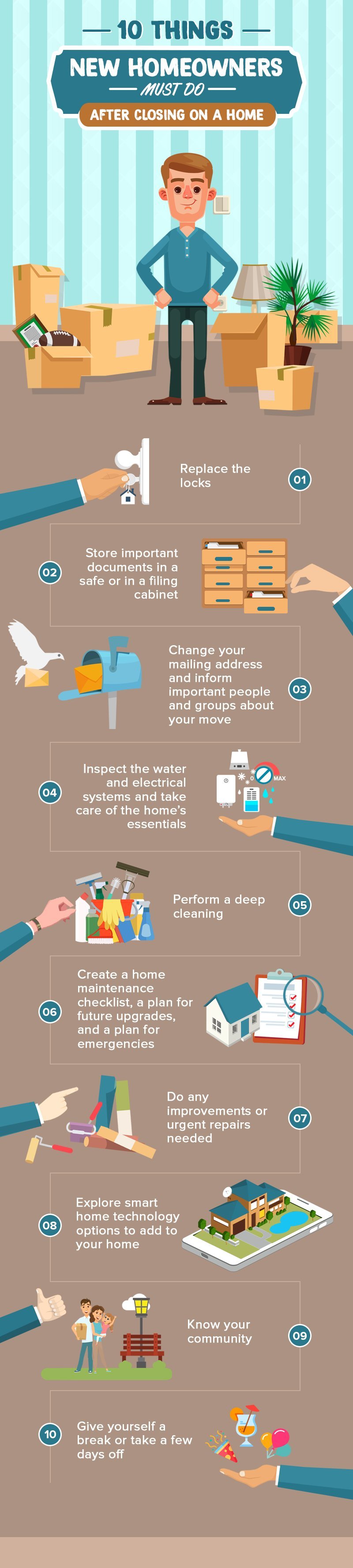
1. Replace the locks
Changing the locks is the most urgent (and obvious) thing to do after getting your new home. After all, there's no way you can make sure how many copies of your house keys exist or even know the people who have them. Yet, many new homeowners still refuse to spend a few hundred dollars to change the locks or re-key them.
It is highly advisable to change the locks on your new home for security purposes. You and your family's safety should be paramount, and the peace of mind knowing that you’re the only one who has the keys to your new abode is more valuable than a few hundred dollars.
If your home is equipped with smart home technology features such as keypad door locks, you should update the keypads and codes after closing. Check for the instruction guides of these electronic keypad locks to know how to change the codes. Don’t forget to update the garage keypads as well if the garage can be opened using the same technology.
2. Store important documents in a safe or in a filing cabinet
It’s important that you make copies of all the documents and paperwork involved from your home purchase and the closing process, specifically your closing statement. You will be needing one of these documents in the future, especially when it’s already time to file your taxes. Store these documents in a safe place, such as a safe or in a filing cabinet, so you know where to find them. It’s also best to keep copies of the documents in a secure cloud-based website or in Google Drive or Dropbox.
3. Change your mailing address and inform important people and groups about your move
Alerting important people and groups about your new address is another major task that buyers must do after closing on a home. First and foremost, alert the United States Postal Service about your move so that important mails will not be delivered to the wrong address. You can conveniently update your address online at the USPS website.
Aside from the USPS, also inform your friends and relatives, the company where you’re working to avoid issues with your workplace benefits, as well as insurance and utility companies. Don’t forget to also update your address in your bank accounts and in your newspaper or magazine subscriptions. If you have children, also alert their school or educational institution about your family’s move.
4. Inspect the water and electrical systems and take care of the home’s essentials
You must have checked the water and electrical systems during your final walk-through with your agent a few days before closing. However, before settling in, check the water heater again and make sure you know the right procedure if you want to adjust the water pressure. You also need to make sure that the HVAC system has a new filter. Familiarize yourself with the location of the shut-off valves and the main circuit breaker so you won’t have to search for it during a homeowner emergency. Likewise, also locate and test the smoke detectors and fire alarms. It will give you peace of mind knowing that every system in your home is functioning properly.
After alerting the important parties of your change of address, don’t forget to also set up your utility accounts, including water, gas, electricity, phone, internet, and so on. If you are still within the same area, you can call these companies to let them know that you’ve moved and transfer your account to your new address. Otherwise, research your local options and set up these necessary services before moving in.
5. Perform a deep cleaning
Completing a deep cleaning is highly recommended after closing on your home and even before you move. If it seems like the previous owner has cleaned up well, then the job will be easier for you. Besides, it’s easier to clean when the house is still empty — even before moving in your things and before the furniture arrives. There will be no obstruction in the way and you can access hard-to-reach places. If you don’t want to do the deep cleaning yourself, hire a professional company or a house cleaner to do it for you.
6. Create a home maintenance checklist, a plan for future upgrades, and a plan for emergencies
One of the major responsibilities of being a homeowner is doing home maintenance tasks, so it’s recommended that you start a home maintenance checklist right away. It just means you take your responsibility seriously and want to avoid having unnecessary stress by not planning for these huge repairs and expenses beforehand. Prepare your maintenance checklist and break down the tasks by seasons or months so that you won’t be easily overwhelmed.
A separate checklist could also be created for your plans for possible upgrades, including both short-term and long-term upgrades and improvements. You could use the home inspection report given to you by the home inspector to help you create a feasible home improvement plan.
It’s critical to note that being a homeowner also means planning for emergencies. Yes, already! You don’t have a landlord now whom you can call anytime, and you also can’t research the names and numbers of the plumbers in your area when the toilet is already clogged or broken. Know the trusted tradespeople or professional companies in your area by asking recommendations from the neighbors or searching online. It also won’t hurt to make an emergency plan for you and your family in case of fire or flood. Look up the numbers of local emergency services aside from 911, create a copy and put them on the fridge where everyone can easily see it. Also, research the local health professionals or local health care providers for any of you and your family’s health concerns.
7. Do any improvements or urgent repairs needed
Once the deep cleaning was completed and the maintenance and upgrades checklists were prepared, you’re now a step closer towards customizing your home. Because it’s easier to do work in the house when it’s still empty, start doing those low-cost home improvements and personalized touches that you want to do even before closing. Freshen up the paint on the walls and ceilings and accomplish the small but relevant repairs before finally settling in.
8. Explore smart home technology options to add to your home
More and more homes are being equipped with smart home technologies nowadays. And with a new piece of technology being released almost every day, you should explore smart home technology options that interest you and which you can apply or install in your home. When you were still a home buyer, you must have thought of these features as an additional factor in the home you choose, but if you decide to sell your house later on, these advanced features could also be a great factor, especially for tech-savvy buyers.
Investigate smart home technology options that will greatly benefit you as a homeowner. Choose if you want to have the Amazon Echo or Google Home, or maybe it will be helpful to install programmable thermostats that you can control using your smartphone. You can also research remote-controlled smart bulbs, or install electronic keypad door locks if your home still doesn’t use one.
9. Know your community
After accomplishing most of these tasks to make your home more livable, take the time to meet the neighbors and know more about the community you now belong to. Perhaps you’ve already met some of them during your house-hunting or home buying process. But after you’ve moved in, knowing your neighbors is a good opportunity to exchange contact information with them in case of an emergency and get truly acquainted with the community. Ask them about the local events around the area, the groups or associations they belong to, as well as local activities. Reach out to the HOA and find information about local social gatherings and activities.
10. Give yourself a break or take a few days off
Your last few weeks must have been full of adrenaline rush and stress brought about by the home buying purchase, the actual closing, fixing all the necessary repairs and doing improvements, and moving and unpacking your stuff. But at long last, congratulations! You’ve just accomplished the American Dream of owning a home. The reality may come as still a bit fuzzy for you, but you’ve done it. So don’t forget to reward yourself with a few days off — bask in your sunlit porch while reading your favorite book or enjoy your outdoor pool just as you dreamed it. You can even throw a housewarming party to formally celebrate and share this important milestone with the people you care about.



![Your Home Buyer Wants To Extend The Closing Date—What Now? [PART 2]](https://images.squarespace-cdn.com/content/v1/68a79317dcab1b51a8b172d5/1764096602490-W0KN3Z48TY2DS319S06N/banner.jpg?format=200w)
![Your Home Buyer Wants To Extend The Closing Date—What Now? [PART 1]](https://images.squarespace-cdn.com/content/v1/68a79317dcab1b51a8b172d5/1763492277776-JQWE2ZAJFP1XBNSA8VIB/banner.jpg?format=200w)

